Raven Black Sculpted Loop Pixie With a Diagonal Crown Part and Flowing Lace Hairline #realfashionsc
A+
A-
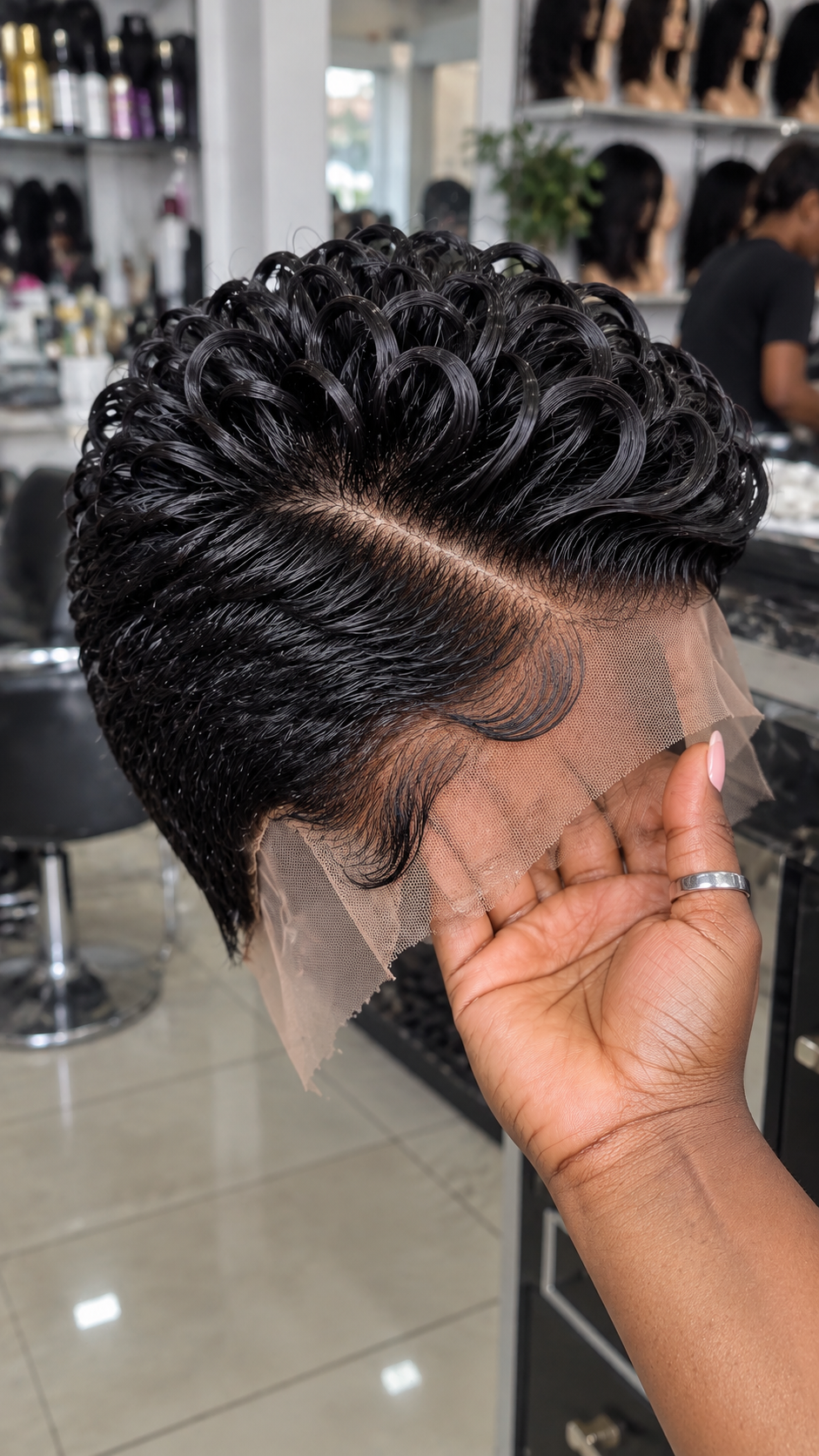
A carefully styled black wig does not need contrasting colors or elaborate shaved-looking artwork to make an impression. Sometimes the most interesting detail is the direction in which the hair moves. This raven black lace pixie demonstrates that principle through an unusual combination of elevated, elongated loops, a diagonal crown parting, and two gracefully curved sections of hair extending across the untrimmed lace near the temple.
The photograph captures the wig being held by hand inside a hair salon before installation. Its upper section contains numerous glossy, open loops that rise from the roots and bend backward. Below them, a diagonal exposed parting separates the elevated hair from a closely arranged side section. Near the front and temple, longer strands curve into two distinctive swooping shapes over the beige lace.
Unlike the compact circular barrel ringlets commonly seen on sculpted pixie wigs, many of the loops in this hairstyle are elongated and directional. Some form narrow arches, while others bend into broader oval shapes. Their arrangement creates an elevated profile without relying on an entirely rounded collection of identical curls.
For buyers interested in a raven black sculpted lace wig, the most important consideration is preserving this directional arrangement. A conventional curly pixie may provide a similar dark color and overall length, but it would not necessarily reproduce the raised loops, diagonal separation, or flowing temple strands that distinguish the photographed design.
A Diagonal Division That Organizes the Entire Hairstyle
Contents
- 1. A Diagonal Division That Organizes the Entire Hairstyle
- 2. Elongated Loops Create a Different Crown Profile
- 3. Raven Black Coloring With Reflective Strand Detail
- 4. The Flowing Temple Strands Are the Most Personal Detail
- 5. The Lower Side Uses Direction Instead of Carved Artwork
- 6. What the Beige Lace Reveals Before Installation
- 7. Finding a Wig Maker for Sculpted Loop Styling
- 8. Ready-Made Alternatives and Custom Styling Costs
- 9. Illustrative Pricing for Raven Black Sculpted Loop Wigs
- 10. Maintaining the Elongated Loop Arrangement
- 11. Inspecting the Wig Before the First Installation
- 12. Where This Sculpted Black Pixie Fits Best
- 13. The Direction of the Hair Is the Defining Detail
- 14. Search Terms
The exposed parting is one of the first details worth examining. It travels diagonally across the upper side, separating the raised loops from the closely arranged hair below. Its path is gently irregular rather than perfectly straight, following the natural direction of the surrounding strands.
Above the separation, the hair rises into a collection of open loops. Below it, the strands lie much closer to the wig’s surface and travel diagonally toward the front temple area.
This difference in direction creates a strong visual boundary without requiring a second hair color. The pale exposed parting contrasts with the black strands on either side, making the separation easy to identify.
The parting also gives the upper arrangement a sense of movement. Instead of appearing as an isolated collection of curls, the loops seem to emerge from a coordinated directional structure.
A custom stylist should treat the diagonal division as an essential component of the hairstyle. Moving it substantially or replacing it with a central part would alter the relationship between the elevated crown and the lower side.
The Importance of Its Starting Position
The visible parting begins near the upper side of the hairstyle and travels toward the front hairline. Its placement determines how much space is available for the raised loops and how the lower strands can be arranged.
If positioned too high, the elevated section may appear narrower. If placed too low, the closely arranged side panel could become disproportionately large.
The photograph does not reveal the complete continuation of the parting across the back of the head. A buyer seeking an accurate custom reproduction should request an additional rear or opposite-side photograph.
The stylist should also confirm whether the parting will appear on the customer’s preferred left or right side when the wig is worn.
Elongated Loops Create a Different Crown Profile
The upper hair contains numerous glossy black loops with visible openings. However, these are not all compact circular ringlets. Several form elongated arches that rise upward before curving backward toward the surrounding hair.
The front and central loops are particularly noticeable because their openings create dark spaces within the otherwise reflective surface. Some loops are relatively narrow, while others have broader oval shapes.
The arrangement is dense, but the individual sections remain distinguishable. This gives the upper hair considerable visual detail without requiring an excessive amount of height.
Near the outer edges, smaller curls and closely overlapping strands help connect the larger loops to the rest of the hairstyle.
The photograph shows a controlled upper arrangement rather than loose curls hanging freely around the face. This distinction should guide any attempt to reproduce the hairstyle.
Why Loop Direction Matters More Than Maximum Volume
A wig maker could increase the volume of a curly pixie by adding more hair, but that would not necessarily create the appearance shown here.
The visual impact comes from the direction of the loops and the spaces between them. The raised sections form a series of overlapping arches, producing depth through their arrangement rather than through excessive density alone.
Too much hair could obscure the openings and make the crown appear heavy. Too little hair might leave gaps between the sections.
A suitable stylist should assess the proposed hair length, density, and setting method before attempting to reproduce the elevated loop arrangement.
The photograph does not establish which tools or styling products were used to create the loops. Those details should be discussed with the wig maker rather than assumed.
Raven Black Coloring With Reflective Strand Detail
The wig appears consistently black throughout the visible upper and lower sections. The glossy strands reflect the salon lighting, creating silver-gray highlights along some of the loops.
These reflections are particularly noticeable where the hair curves sharply. The outer surfaces of the loops catch more light, while the openings and overlapping roots remain much darker.
No clearly separate blonde, brown, copper, or burgundy color sections are visible. The hairstyle’s contrast comes primarily from light, shadow, and strand direction.
Customers seeking a similar appearance should begin with a natural black or raven black shade rather than requesting unnecessary highlights.
The exact commercial color number cannot be established from the photograph. Sellers may use different naming or numbering systems, so actual product photographs remain important.
Gloss Does Not Confirm Fiber Quality
The reflective appearance of the hair should not be treated as proof that the wig contains human hair. Synthetic fibers and blends can also produce strong reflections under bright lighting.
The photograph does not establish the material, manufacturer, or coloring history.
Before purchasing, ask the seller to confirm the fiber composition and provide appropriate washing and styling instructions.
The buyer should focus on whether the material can support the elongated loop arrangement and retain the intended appearance during wear.
The Flowing Temple Strands Are the Most Personal Detail
Near the front and temple, the hairstyle introduces a softer form of movement. Several closely arranged strands curve across the beige lace, creating a pronounced swooping section.
Below that section, another group of longer strands forms a separate curved shape that descends toward the lower temple area.
These two flowing sections are visually different from the elevated loops above. They lie closer to the lace and follow more elongated paths, creating a decorative transition between the compact side hair and the front hairline.
The upper swoop curves inward before turning outward, while the lower section forms a longer descending bend.
The photograph shows these strands before installation, so their final position against a wearer’s skin cannot be confirmed. Their appearance may change slightly depending on how the lace is fitted.
Preserving the Curved Hairline During Installation
The temple strands should be considered before trimming the lace. Their arrangement extends across the visible mesh, and removing too much lace could affect the available space for positioning them.
A professional wig stylist should first establish the correct hairline placement and determine how the curved sections will sit against the wearer’s temple.
The customer should explain whether both swooping sections are essential to the desired appearance.
If the stylist proposes shortening or rearranging them, the effect on the original design should be discussed before any permanent alteration.
These details are especially important because the wig does not rely on a prominent geometric side pattern. The flowing temple strands provide much of the lower section’s decorative character.
The Lower Side Uses Direction Instead of Carved Artwork
The visible side hair is closely arranged and follows a backward-to-forward directional pattern beneath the diagonal parting.
The strands appear glossy and compact, with fine lines of reflection emphasizing their alignment.
Unlike wigs featuring lightning bolts, double crescents, or branching decorative channels, this design does not show a prominent carved-looking temple pattern.
The diagonal upper separation is the main exposed channel. The lower side derives its appearance from the arrangement of the hair itself.
This distinction is important when communicating with a custom maker. Requesting additional shaved-looking lines would introduce details that are not present in the reference.
The closely arranged lower hair should remain compact enough to preserve the contrast with the elevated loops above.
What the Beige Lace Reveals Before Installation
The wig is photographed with its lace extending beyond the front and side hairline. The beige mesh is clearly visible where the hand supports the unit.
The lace has not been trimmed to a final wearing position. Its exposed perimeter allows the viewer to distinguish the styled hairline from the surrounding mesh.
The photograph does not provide a complete view of the interior cap. Attachment combs, adjustment straps, and other hardware cannot be reliably identified from this angle.
The lace’s exact commercial grade is also unknown. A fine mesh appearance does not establish that the material is HD lace.
Buyers should request an underside photograph showing the full cap, lace dimensions, and any available attachment hardware before purchase.
Cap Measurements and Hairline Position
A proper fitting should begin with accurate head measurements. Circumference, front-to-nape distance, and ear-to-ear width can influence how the wig sits.
The diagonal parting and flowing temple strands make positioning particularly important. If the wig sits too far forward or backward, the curved hairline sections may not align as intended.
The lace should be trimmed only after the cap has been fitted and the desired hairline established.
The photograph alone does not prove that the wig is glueless or that adhesive is required. The appropriate attachment method depends on the actual cap construction and the wearer’s needs.
Finding a Wig Maker for Sculpted Loop Styling
Customers seeking a close reproduction should look for stylists experienced in sculpted pixie wigs, elevated loop arrangements, and detailed lace hairline work.
A general curly wig seller may offer similar black units, but ordinary curls may not reproduce the elongated arches visible in the photograph.
Review portfolios for examples of open-loop styling, directional crown arrangements, and carefully placed temple strands.
When contacting a maker, send the reference photograph and explain that the upper loops should be elongated rather than uniformly circular.
The diagonal parting and two flowing temple sections should also be identified as essential design elements.
Preparing a Clear Custom Order
Ask the seller whether the proposed hair material can support the raised loops and whether the hairstyle will arrive fully styled.
Confirm the desired black shade, cap measurements, lace dimensions, and preferred side orientation.
Request photographs of previous work involving sculpted curls and lace hairline customization.
The seller should explain whether the quoted price includes the loop arrangement, diagonal parting, temple styling, and installation preparation.
For online orders, obtain written confirmation of the agreed design, production time, shipping arrangements, and revision policy.
Ready-Made Alternatives and Custom Styling Costs
A ready-made black curly pixie may provide a similar color and compact silhouette at a lower initial cost.
However, many ready-made units contain ordinary spiral curls rather than the elongated loops shown in this reference.
Buyers who prioritize the exact crown arrangement may benefit from commissioning a custom wig.
A ready-made base could still be suitable if its hair length, density, and cap construction allow the stylist to create the desired loops.
Before purchasing a base unit, ask the stylist whether it can support the diagonal parting and flowing temple strands.
Extensive corrective styling may increase the total expense, so the least expensive starting wig is not always the most economical option.
Illustrative Pricing for Raven Black Sculpted Loop Wigs
The potential cost of this hairstyle depends on the selected hair material, cap construction, elongated loop styling, diagonal parting work, and detailed lace hairline arrangement.
The following USD amounts are illustrative planning ranges only. They are not verified live retail prices or quotations for the photographed wig.
| Wig Category | Illustrative USD Range | Relevant Cost Considerations |
|---|---|---|
| Premium Custom | $345–$800+ | Individual elongated loop placement, diagonal crown parting, custom temple swoops, and personalized cap fitting. |
| Standard Custom | $175–$405 | Specialized loop styling and directional side arrangement on a suitable prepared wig foundation. |
| Basic Human Hair | $95–$255 | A possible starting unit requiring additional curl setting, parting work, and hairline customization. |
| Premium Synthetic | $65–$185 | May offer a pre-styled black curly alternative if the fiber and construction support the elevated loop arrangement. |
| Basic Synthetic | $25–$90 | A lower-budget black curly option that may not reproduce the precise elongated loops or temple styling. |
The photograph does not establish whether the wig contains human hair, synthetic fiber, or a blend. These categories describe possible purchasing routes rather than verified properties of the displayed unit.
Additional charges may include lace trimming, cap adjustment, professional installation, shipping, and future styling restoration.
When comparing quotations, ask whether the sculpted loops and temple strands are included in the price. A generic curly wig should not be compared directly with a fully customized unit.
Maintaining the Elongated Loop Arrangement
The upper loops depend on retaining their open shapes and directional placement. Repeated brushing could disturb their arrangement and reduce the visible openings.
Customers should avoid pulling the loops apart simply to increase volume. The compact, elevated structure is central to the hairstyle.
Ask the wig maker whether the loops can be refreshed at home or whether professional restyling is recommended after washing.
If the wig contains human hair, cleansing should account for any setting products or styling techniques used during preparation.
If synthetic fiber is used, heat tools should not be applied unless the manufacturer confirms the material’s heat tolerance.
Protecting the Temple Swoops
The curved temple strands require careful handling because their appearance depends on maintaining specific directional paths.
Repeated rubbing or combing across the lace may disturb the upper and lower swoops.
A stylist should explain how to refresh these sections without changing their shape or pulling unnecessarily on the lace.
Any trimming should be performed cautiously because shortening the strands could permanently alter the design.
The diagonal parting should also remain clear, with neighboring hair kept aligned along the exposed separation.
Inspecting the Wig Before the First Installation
When the unit arrives, examine the upper loops to determine whether they retain the elongated shapes visible in the reference.
Check the diagonal parting and confirm that it separates the elevated crown from the closely arranged lower side.
Inspect the two flowing temple sections to ensure they follow the agreed directional arrangement.
Review the lace and cap for visible damage before fitting.
If the wig was custom-made, any significant differences should be discussed with the seller before permanent trimming or restyling.
Where This Sculpted Black Pixie Fits Best
The raven black color gives this hairstyle considerable versatility, while the elevated loops and flowing temple strands provide distinctive visual detail.
It may appeal to customers seeking a sculpted pixie for celebrations, portrait photography, fashion events, or personal everyday styling.
The dark color can coordinate with black, white, cream, beige, and a wide range of other clothing shades.
Because the hairstyle already contains detailed directional movement, simple accessories may allow the hair to remain the main visual focus.
For frequent wear, the buyer should consider the maintenance required to preserve the elongated loops and lace hairline arrangement.
The Direction of the Hair Is the Defining Detail
This wig demonstrates that black hair can create considerable visual interest through carefully planned movement alone.
The diagonal crown parting organizes the upper and lower sections, while the elongated loops introduce height and depth. The flowing temple strands add a softer decorative element without relying on carved-looking side artwork.
The exposed beige lace also highlights the importance of confirming cap construction and fitting requirements before installation.
For customers seeking a faithful reproduction, the priority should be a wig maker who understands the relationship between the raised loops, diagonal separation, and carefully arranged temple hair.
When these elements are reproduced accurately, the result captures the distinctive character of this raven black sculpted lace pixie without requiring additional colors or unnecessary decorative patterns.
Search Terms
Raven black elongated loop lace wig · Diagonal crown parting pixie hairstyle · Black open oval curl crown · Flowing temple swoop lace hairline · Glossy black sculpted arch curls · Beige untrimmed lace side part wig · Black pixie with double temple swoops · Raised loop crown directional side styling
Comments
Related Posts