Burnished Copper Ribbon Loop Wig With an Espresso Side Sweep and Exposed Lace Front #realfashionsc
A+
A-
Imagine ordering a copper pixie wig because you love its color, only to discover that the delivered hairstyle has ordinary curls instead of the tall, backward-bending loops you expected. That difference would matter enormously with the hairpiece shown here. Its appeal depends on an unusual relationship between upright copper ribbons, a deep espresso foundation, and a low, directional side panel. The color attracts attention first, but the arrangement of the hair is what makes the design recognizable.
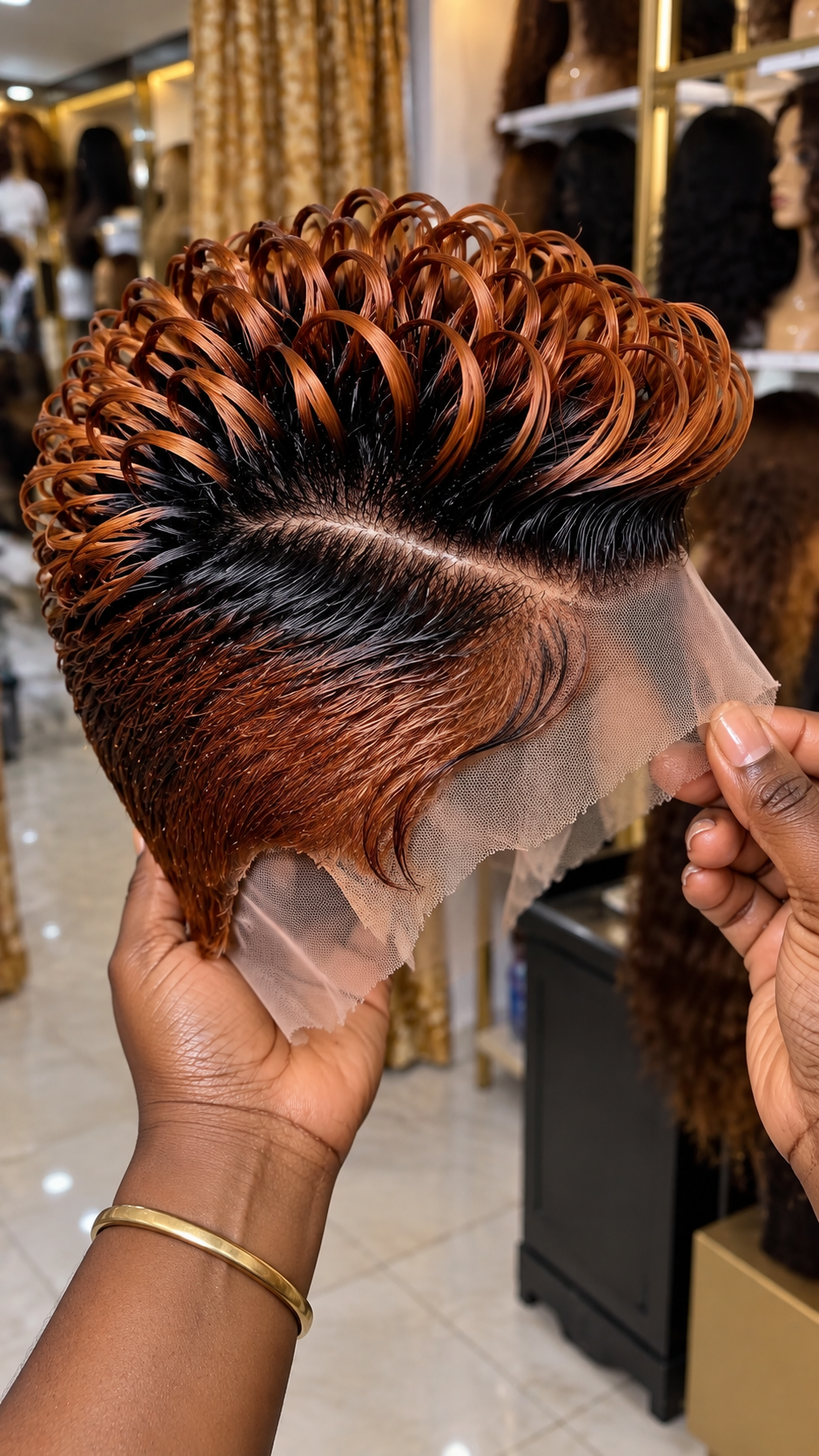
Photographed between two hands in a wig retail environment, this uninstalled hairpiece reveals a profile that would be difficult to appreciate from a conventional front-facing catalog photograph. The upper hair rises into elongated arches that bend backward, while the lower section follows a diagonal direction close to the cap. A pale parting channel separates these areas, and a generous section of untrimmed beige lace extends beyond the front hairline.
The most useful way to approach this wig is as a precision styling project rather than simply a colored curly unit. Anyone interested in purchasing or reproducing it should evaluate the length of the copper loops, the direction of their bends, the amount of dark hair remaining at their bases, and the relationship between the parting and the front lace. Those details will determine whether the finished hairstyle resembles the reference.
The Difference Between a Standing Ribbon Loop and a Round Ringlet
Contents
- 1. The Difference Between a Standing Ribbon Loop and a Round Ringlet
- 2. Copper Above, Espresso Beneath: Understanding the Color Boundary
- 3. A Diagonal Parting That Organizes the Entire Profile
- 4. The Lower Side Is a Directional Sweep, Not a Cluster of Curls
- 5. What the Front Lace Reveals Before Installation
- 6. Commissioning a Wig With the Correct Loop Direction
- 7. Where to Look for a Comparable Wig
- 8. Evaluating Styling Labor Before Comparing Prices
- 9. Illustrative Prices for an Upright Copper Loop Pixie Wig
- 10. Planning the First Salon Appointment
- 11. Keeping the Copper Arches From Collapsing
- 12. Inspecting the Unseen Areas Before Final Payment
- 13. A Copper Pixie That Depends on Shape as Much as Color
- 14. Search Terms
The copper hair does not form a collection of compact circular coils sitting flat across the crown. Instead, numerous elongated loops rise vertically from a dark foundation before curving backward. Some resemble narrow arches, while others form taller oval openings with their ends returning toward the hair beneath them.
The upper silhouette has a pronounced upward direction. Near the front, several long copper sections travel away from the hairline and curve over the top. Farther toward the visible rear, smaller loops overlap and fill the spaces between the larger formations.
This creates a distinctive layered appearance. The hair looks as though individual sections have been lifted, bent, and positioned into a coordinated arrangement rather than simply curled and allowed to fall.
The openings inside many loops remain visible, although their shapes are more elongated than the circular holes found in tightly coiled ringlet wigs. That difference is essential when describing the hairstyle to a manufacturer.
A generic spiral-curl pixie may have similar color and overall length but will not necessarily reproduce these upright arches. For this reference, the angle at which the hair leaves the foundation is as important as the curl itself.
The Forward Edge Needs Particular Attention
Several prominent copper ribbons rise from the front-upper area, creating an elevated profile above the darker hairline. Their direction gives the hairstyle height without requiring long hair to fall over the face.
The arches are not arranged in perfectly identical rows. Their lengths, widths, and orientations vary, with some loops bending toward neighboring sections.
That variation prevents the upper arrangement from resembling a rigid collection of identical rings. A custom wig maker should reproduce the general flow and proportions without attempting to make every loop mechanically uniform.
Increasing the hair length too much could cause the arches to become taller or collapse into hanging curls. Reducing it excessively could eliminate the elongated openings that distinguish the design.
Copper Above, Espresso Beneath: Understanding the Color Boundary
The upper hair displays warm copper, cinnamon, and reddish amber tones. Bright reflections travel along the outer surfaces of the raised loops, while darker strands remain visible between them.
At their bases, many copper sections transition into an almost black espresso foundation. The dark hair continues across the upper-side area and into the flatter lower section.
This produces a particularly strong color contrast. The copper loops appear to emerge from the dark hair rather than forming an entirely light-colored hairstyle.
The lower side also contains warmer brown and copper reflections, especially toward the lower visible edge. However, the upper loops are more vividly copper-colored than the central side panel.
The photograph was taken under warm retail lighting, which may intensify the reddish and golden reflections. It cannot establish the precise dye formula or whether every tonal variation comes from intentional coloring.
Buyers should request a neutral-light photograph before approving a shade described as copper, auburn, cinnamon, or burnt orange. These names are used inconsistently between suppliers.
Protecting the Dark Foundation During Color Customization
A custom reproduction should not automatically be colored copper from root to tip. Doing so would eliminate much of the dark contrast visible beneath the arches.
Instead, discuss the desired distribution of color with the maker. The reference shows a predominantly dark foundation supporting brighter copper upper lengths, with warmer tones also visible through portions of the lower hair.
If the selected material is human hair, the maker should evaluate its previous processing before attempting additional coloring. If synthetic fiber is chosen, the color may need to be incorporated during production rather than added afterward.
The photograph does not confirm which material was used. Buyers should never assume that a wig can be safely bleached, dyed, or heat-colored simply because its appearance resembles treated human hair.
A Diagonal Parting That Organizes the Entire Profile
A pale separation channel runs diagonally through the visible side, beginning near the rearward upper area and traveling toward the front temple. It divides the dark foundation beneath the copper arches from the flatter side hair.
The channel is not a series of multiple decorative stripes. One principal parting is visible, and it follows a relatively continuous diagonal path with a gentle change in direction near the front.
Above this channel, the dark strands rise toward the copper loop arrangement. Below it, the hair lies closer to the wig base and follows a downward, forward-sweeping direction.
The contrast between these two directions gives the hairstyle its architectural appearance. Even without the copper coloring, the upper and lower sections would remain visibly different.
The photograph does not establish whether the separation was created through parting, cutting, or a combination of styling methods. Describing the visible channel is more reliable than claiming it is a razor-carved line.
For a reproduction, the stylist should understand where the channel begins and ends before arranging the surrounding hair. Moving the separation could change the perceived width of the upper hairstyle and the balance of the side panel.
The Lower Side Is a Directional Sweep, Not a Cluster of Curls
Below the parting, dark strands are arranged diagonally across the side. Their surfaces reflect light in long, narrow lines, making the hair direction easy to follow.
The lower section appears relatively close-fitting, although it retains visible hair length and does not resemble an exposed skin fade.
Near the lower edge, warmer copper-brown strands become more prominent. These hairs continue toward the front, where the side narrows into a tapered, curved section above the untrimmed lace.
This area is important because it balances the elevated upper arches. If the side were made equally voluminous, the hairstyle would lose the strong contrast between raised loops and close-fitting hair.
Likewise, cutting the side too aggressively could expose the underlying cap or produce a much harsher appearance than the reference.
Anyone ordering this design should specify that the side retains directional hair coverage rather than requesting a completely shaved temple.
What the Front Lace Reveals Before Installation
The photograph shows a broad beige-toned lace margin extending beyond the front and temple. The lace remains untrimmed and is being held outward by one hand, making the mesh easy to inspect.
Fine hairs are visible near the front transition, with several curved strands positioned close to the lace boundary. These strands appear to connect the dark upper foundation to the forward edge of the wig.
The lace extends beyond the styled hair and hangs freely because the unit has not yet been installed. Its appearance against a hand does not establish how closely it will match the skin of a future wearer.
Nor does the visible mesh establish that the product uses HD lace or another particular commercial lace category. Those specifications require confirmation from the supplier.
The complete cap interior is not exposed. Although dark material can be seen beneath parts of the wig, the photograph does not verify the number of combs, strap arrangement, or complete construction method.
Why Fitting Must Precede Lace Cutting
This hairstyle has a strong directional relationship between the upper arches, diagonal parting, and front hairline. Positioning the cap incorrectly may alter how all three appear against the wearer’s face.
A stylist should first place the wig on the head, check the cap fit, and examine the position of the parting relative to the temple.
Only after confirming the intended placement should excess lace be trimmed where necessary. Cutting too much lace before fitting may reduce the available adjustment options.
If the wearer needs a different hairline shape, the stylist should consider whether the adjustment can be made without disturbing the copper arches or exposing the supporting structure.
Commissioning a Wig With the Correct Loop Direction
The most effective custom-order request should begin with the shape of the copper arches rather than the color name.
Send the reference photograph and explain that the upper hair must rise from a dark foundation into elongated, backward-bending loops. Identify the taller arches near the front and the smaller overlapping formations toward the rear.
Next, specify the dark espresso foundation and warm copper lengths. Ask whether the maker can preserve the darker bases while producing the desired color intensity.
Then describe the single diagonal parting and the close-fitting lower side. Make clear that additional carved lines or a completely shaved side are not part of the reference.
Finally, provide the intended wearer’s cap measurements and request information about the lace, attachment system, and styling material.
These instructions are more useful than asking for a copper pixie wig with curls because they identify the design elements that distinguish this particular hairpiece.
Where to Look for a Comparable Wig
Specialized wig boutiques and custom wig makers are more promising starting points than general listings for ordinary curly pixie wigs.
Search for sculpted ribbon-loop wigs, copper pixie lace wigs, directional curl hairpieces, and custom loop-curl hairstyles. Compare actual photographs rather than relying solely on listing titles.
Some ready-made wigs may have similar copper coloring but use circular ringlets instead of elongated arches. Others may reproduce the upper structure while omitting the dark foundation or diagonal parting.
If a ready-made product appears suitable, request a side photograph and an elevated view of the upper hair. Ask whether the seller’s images show the exact unit available for shipment.
For a custom order, review examples of previous sculpted hairstyles. A maker experienced only with loose curls may not be familiar with arranging long, upright loops.
Do not pay for a custom reproduction until the supplier has confirmed which aspects of the reference can be achieved with the proposed materials.
Evaluating Styling Labor Before Comparing Prices
The unusual upper arrangement may require more labor than a conventional curled pixie, particularly if the arches are positioned individually.
The cost may also depend on the chosen hair material, color processing, lace coverage, cap construction, and the amount of hand styling required.
However, the photograph does not reveal how long the hairstyle took to create or whether its loops were arranged manually, manufactured in a prepared form, or produced using another method.
When comparing quotations, ask suppliers to explain what their price includes. A lower-priced wig with ordinary curls may require extensive restyling, while a more expensive unit may already have the desired structure.
The best comparison is therefore between finished products that genuinely resemble the reference, not merely between wigs described using similar color names.
Illustrative Prices for an Upright Copper Loop Pixie Wig
The following US dollar ranges are illustrative planning estimates, not verified current retail prices. They describe possible purchasing categories and do not establish the material or value of the photographed unit.
| Wig Category | Illustrative USD Range | Possible Cost Components |
|---|---|---|
| Premium Custom | $330–$780+ | Personalized cap construction, detailed upright loop placement, copper color customization, and specialist finishing. |
| Standard Custom | $180–$405 | Selected cap adjustments, directional loop styling, and customized dark-to-copper color distribution. |
| Basic Human Hair | $105–$270 | A human-hair base unit that may require additional coloring and professional arch-setting work. |
| Premium Synthetic | $70–$200 | A higher-grade synthetic option with potentially prearranged loops and a prepared lace front. |
| Basic Synthetic | $30–$105 | A budget category where exact loop direction, color distribution, and styling flexibility may be limited. |
These categories are not confirmed versions of the photographed wig. The exact hairstyle may be unavailable in some materials or price ranges.
Ask whether shipping, installation, lace preparation, cap adjustments, and future restyling are included. A written quotation should distinguish the price of the wig from additional salon services.
Because the copper arches are central to the design, their accuracy should carry considerable weight when evaluating value.
Planning the First Salon Appointment
After receiving the wig, inspect the upper arches before handling the lace. Check whether the loops remain upright, whether their openings are visible, and whether the copper coloring matches the agreed reference.
Next, examine the diagonal parting and lower side. Make sure the side hair has not been arranged in a different direction or cut into an unintended pattern.
At the salon, the stylist should position the cap and evaluate the hairstyle from the front and side. The upper loops should remain balanced relative to the forehead, while the parting should sit appropriately near the temple.
Any necessary lace trimming should follow this fitting assessment.
If the hairstyle requires correction, choose a stylist experienced in sculpted wig setting. Ordinary curling techniques may not recreate the long upright arches.
When booking, ask whether the salon offers structured curl restoration as well as lace fitting. This can be useful if the wig needs maintenance after shipping or repeated wear.
Keeping the Copper Arches From Collapsing
The most significant maintenance risk is loss of the upright loop structure. These curls depend on their elevated shape, and flattening them could change the hairstyle into a more conventional swept-back pixie.
Avoid brushing through the arches without guidance from the maker. Separating the grouped strands may disturb their direction and reduce the visible openings.
Before washing, determine whether the loops are intended to retain their shape when wet or require professional resetting afterward.
If the wig is synthetic, do not use hot tools unless the manufacturer confirms the fiber’s heat tolerance. If it is human hair, any resetting method should account for previous chemical processing and the original styling technique.
The copper color may also require attention. For confirmed color-treated human hair, repeated washing, high temperatures, and sunlight may affect color longevity. Conventional dyeing should not be assumed suitable for synthetic fibers.
When the wig is not being worn, avoid placing pressure directly on the raised arches. Ask the supplier about an appropriate storage method that supports the cap without compressing the hairstyle.
Inspecting the Unseen Areas Before Final Payment
The reference photograph offers a strong side profile, but it does not reveal the complete rear, opposite temple, or underside.
Request a direct front view to assess how the arches are distributed across the forehead. A photograph from above can reveal whether the copper loops continue consistently across the crown.
An opposite-side image will establish whether the diagonal parting is repeated or whether the second side has a different arrangement.
A rear photograph is necessary to evaluate how the copper arches transition toward the nape.
Finally, an underside photograph should confirm the cap construction, lace coverage, and attachment components.
These images are particularly valuable for custom orders because they allow the buyer to compare the completed product with the agreed design before shipping.
A Copper Pixie That Depends on Shape as Much as Color
The strongest characteristic of this wig is its sequence of elongated copper arches rising from a dark espresso foundation. The upper hair bends backward in broad loops, while the lower side follows a flatter diagonal direction beneath one prominent parting.
The warm copper lengths provide visual brightness, but the dark foundation is equally important. Without it, the hairstyle would lose much of the contrast that separates the raised arches from the lower hair.
The untrimmed lace confirms that the unit is being shown before installation, although its exact lace grade, fiber composition, and complete cap construction remain unverified.
For a buyer seeking this appearance, the most effective approach is to prioritize the loop direction, color boundary, side coverage, and fitting requirements before choosing a supplier.
A successful reproduction should preserve the upright copper arches and the compact lower profile without adding unrelated curls or decorative side patterns. Those details are what distinguish this hairstyle from an ordinary copper-colored pixie wig.
Search Terms
Burnished copper upright ribbon loop wig · Espresso root copper arch pixie · Elongated backward bending curl hairpiece · Copper black diagonal part lace wig · Cinnamon auburn standing loop crown · Flat swept side copper pixie wig · Untrimmed beige front mesh hairpiece · Dark foundation copper oval curl wig
Comments
Related Posts